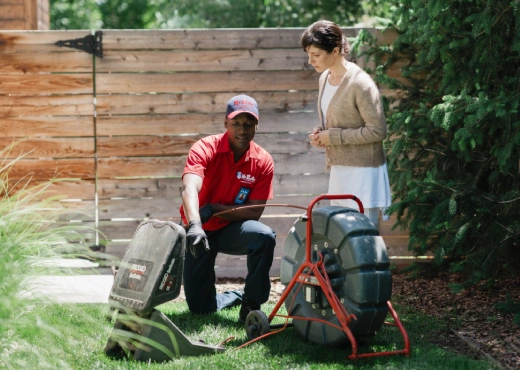

Most sewers we line in Edmonton are clay tile; the pipe builders laid under most homes were put up before the early 1980s. If you own a 1960s bungalow in Aspen Gardens, the pipe under your yard is likely a chain of short clay sections, and every joint gives the neighbourhood's big trees a way in. Clay doesn't flex. As roots spread and soil shifts, it cracks over decades, and we can turn those sections into one continuous cured-in-place pipe (CIPP) that roots can't push through.
Homes from the 1950s are a different story. Many got tar paper sewer pipe, which you'll also hear called No-Corrode or Orangeburg, and it delaminates from the inside as it ages. We don't line it, because a liner needs a host pipe that holds its shape. If your inspection shows it, we'll help you plan sewer line replacement instead, and we can often still do that work without a long trench.
Lining makes the most sense when your sewer runs under something you'd hate to lose, like a heated garage slab or a mature spruce out front. We can reach lines of 100 feet or more from your cleanout and reopen branch connections with a cutting tool after the cure. Your liner is about 3 mm thick, roughly an eighth of an inch. You give up a sliver of diameter and get a smooth wall that grease has a harder time clinging to. You'll likely see fewer clogs.